The french expedition
How flat is the Earth? An Orange or a lemon?
In 1736, eight scientists, mostly from France, arrived in Torneå around midsummer. The town was then part of Sweden but is today part of Finland and a neighbour of Haparanda. They had been sent by the French Academy of Sciences to settle one of the hottest scientific questions of the time: is the Earth flattened at the poles (as Newton in England argued) or elongated at the poles (as Cassini in France argued)? In the fine salons, the question was put like this: is the Earth shaped like an orange or a lemon?
The expedition was led by the mathematician Pierre Louis Moreau de Maupertuis, a worldly Parisian who believed in Newton's theory. With him he had, among others, the astronomer Anders Celsius, the same Celsius who later invented the temperature scale.
The result? Newton was right. Maupertuis came home a hero and had himself portrayed in Sami fur clothing with one hand pressing down on a globe, as if he had flattened the planet himself. The painting was exhibited at the Louvre in 1741 and spread across Europe as a reproduction.
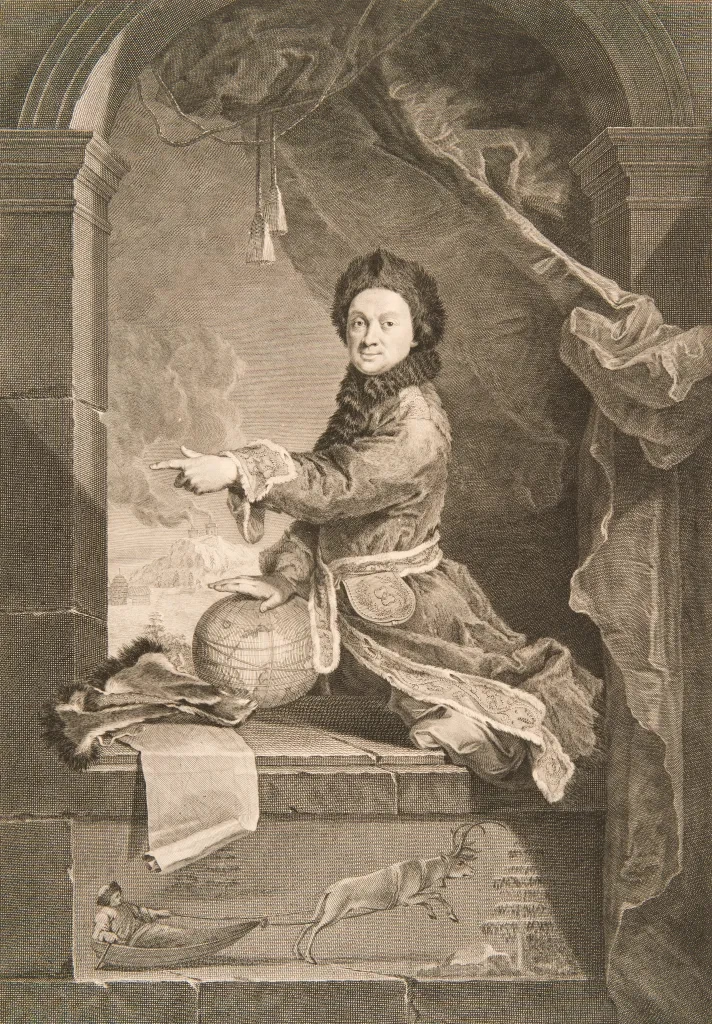
The leader of the expedition, Pierre de Maupertuis, dressed in Sámi fur clothing as he is flattening the earth with his hand. Below him is a portrayal of a reindeer pulling him in a sled (from which he fell often when being transported).
A language from another time
The expedition made many visits around the Torne Valley that had nothing to do with the measurements. One of these was a visit to the Vinsa Stone at Käymäjärvi near Pajala. The stone had been known to academics since the 1680s and to the local population for much longer than that. The locals held that the rune-like marks on the stone were a secret message from history, while the academic theory was that they might be the world's oldest runic inscriptions.
The snow that still covered the ground made the stone hard to find. After hours of searching they finally found it, and they built a fire next to it to melt all the snow. Celsius quickly concluded that the carvings were not runes. Maupertuis speculated about whether they might be signs from a lost civilisation, but also that they could possibly have been formed by nature itself.
What they both agreed on was that it could not have been earlier generations of Sámi, even though this was the account of history that existed in the Sámi culture on that spot. Maupertuis dismissed them by saying that one could not take theories seriously when they came from a people who “do not know their own age and often do not even know their own mother”, a statement that already at the time was seen as a condescending caricature, portraying many indigenous peoples, in this case the Sámi, as “primitive” and lacking the same kind of stable family structures as people in the rest of the world, which of course they had. Ironically, they had been guided to the stone by the vicar of Övertorneå, Erik Brunnius, with whom they also stayed for much of the time. Brunnius had written about the stone earlier and could also have told Maupertuis that he had church records in which motherhood was documented for Sámi people as well.

The markings on the Vinsa stone has been used to argue that Sweden was the center of civilization and that our runes later inspired the greek alphabet. It has been speculated by modern historians that the stone and its markings could be part of a sámi sieidi, a sort of sacrifical stone that marks a place for offerings.
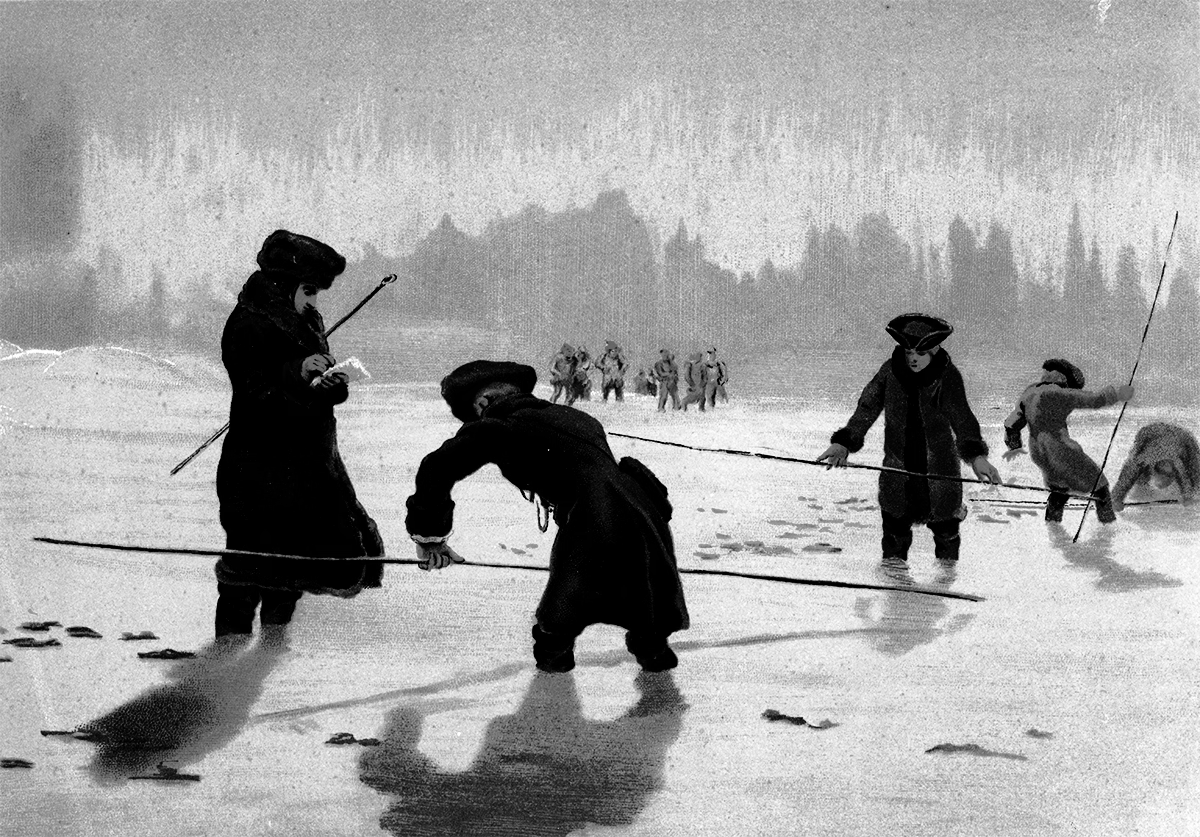
The expedition used the frozen river as a straight baseline to measure against. In this etching, two different groups measure a distance of about 14.4 kilometers by hand while walking through deep snow. During the measurement, which lasted for many hours late into the day, the groups complained that the alcohol they brought with them froze to ice. This happens at temperatures between -30 and -40 degrees. The northern lights are visible in the background.
The expedition's most cringeworthy moments
- The scientists were poorly prepared for the fact that there were mosquitoes and other insects in northern Sweden. They suffered so much from this that they often ate their meals sitting in the thick smoke from campfires.
- Voltaire, one of the most famous philosophers in world history, mocks the expedition, and Maupertuis above all, in the book Micromégas, known as the first story about aliens visiting Earth. Voltaire writes about how pretentious, self-centred, and poor a writer Maupertuis is considered to be in the eyes of an alien giant.
- The scientists brought soldiers and servants along throughout the trip to handle everything practical apart from the actual calculations. They had such practical difficulties with everything other than the maths that they even had trouble walking on snow and fell constantly, on one occasion so badly that Maupertuis himself injured his hand seriously. It is not hard to imagine that the locals were amused by Europe's most prominent scientists tumbling around in a way that not even small children did.
- On Iso-Horila outside Ylitornio, the forest burned down after they left a poorly extinguished campfire. Maupertuis had to send 30 men from the Västerbotten Regiment to try to put it out.
- The journey home ended in shipwreck in the Bay of Bothnia outside the city of Piteå. The measurement data and papers were saved, but many instruments were lost.
- When the Frenchmen returned to Paris, Maupertuis and his colleague Camus kept in touch with the two sisters they had met in Torneå, Christine and Elisabeth Planström. At the time, Christine was around 20 and Elisabeth about 22. A massive scandal broke out in Torneå, with locals gossiping about what the women had been up to with the Frenchmen. To salvage their honor, the sisters felt their only option was to marry their suitors. The sisters arrived in Paris in 1738, accompanied by their mother. However, both men were mostly inconvenienced by their arrival, and Maupertuis even fled Paris to go home to his mother in Bretagne. This caused a major scandal in the Parisian press. King Louis XV, displeased that Swedish citizens had been treated so poorly, resolved the matter by having the sisters convert to Catholicism, which allowed him to grant them a lifelong royal pension.
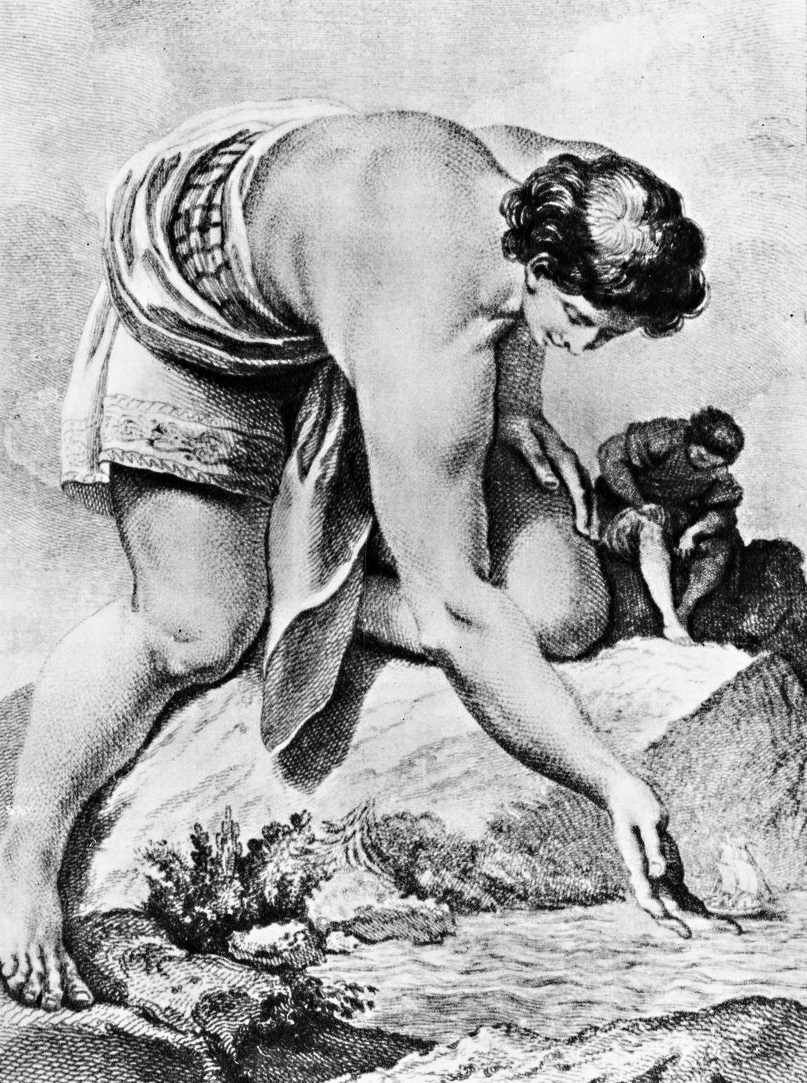
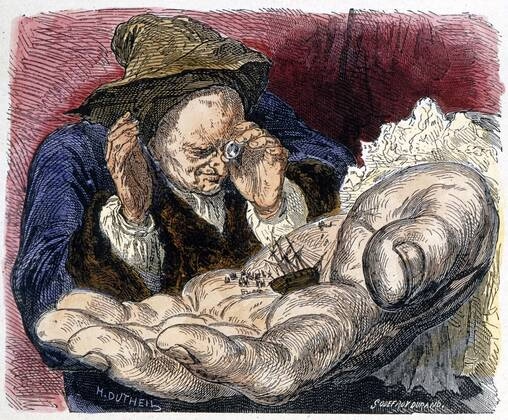
The 32 km tall Micromégas, in Voltaire's satirical story about an alien from the fictional solar system around the star Sirius, visits Earth together with his slightly shorter friend (only 3 km tall) from Saturn. In one of the illustrations, Micromégas picks up Maupertuis' ship in the Gulf of Bothnia and hands "the animal" over to his friend to examine, as he thinks it is some kind of insect-like creature.
Do you have something to add to this topic? Tell us your story.
Har du något att berätta om det här ämnet eller något annat du tror skulle passa på sidan? Skicka in din berättelse.